A replay-fault pilot that stopped.
One promising checkpoint did not reproduce consistently across six training roots
One excluded calibration root showed a 13.2% performance deficit after its faulty replay records had been evicted. Across six predeclared roots, only three deficits were positive and the median was 1.15%. The study did not meet its continuation rule.
THE QUESTION
Can a replay fault outlive its records?
A faulty target changes a network. That network supplies later bootstrap targets, so an error might continue to matter after the record that caused it has left replay.
I tested that possibility with the compact reference DQN for MinAtar Breakout. After 500,000 training frames, each complete checkpoint was copied into clean and fault branches. The clean replay buffer was unchanged. In the fault branch, the 16 newest rewards equal to were stored as . Every subsequently collected reward was correct.
Networks, optimizer state, environment state, replay position, and random states began identically. A clean/clean sham fork had to continue bit-identically before either treated pair could run. The modified records carried stable IDs, making every replay draw and the final eviction directly observable.
- Benchmark
- MinAtar Breakout
- Replay
- Uniform FIFO · 100k
- Continuation
- 200k frames
- Evaluation
- 20 fixed episodes / 10k
For each training root, I integrated clean return minus fault return from the first evaluation after every altered record was gone through the fixed horizon. Dividing by clean performance over that interval produced the signed relative post-eviction deficit, . Positive values mean the fault branch performed worse.
CALIBRATION
One root selected the fault size.
An excluded checkpoint tested fault sizes in order. The fixed rule was to lock the first size with at least 10% post-eviction deficit, or stop after 16. The six pilot roots and their evaluation panels had already been declared.
EXCLUDED CALIBRATION ROOT
| Altered rewards | Post-eviction deficit | Decision |
|---|---|---|
| 4 | 9.13% | Advance |
| 8 | 9.66% | Advance |
| 16 | 13.16% | Lock |
Sixteen altered rewards cleared the threshold. That result chose the pilot intervention; it did not establish an effect across independently trained agents.
THE RESULT
The calibration signal did not reproduce consistently.
Three roots showed positive post-eviction deficits and three showed negative deficits. The median was 1.15%, well below the predeclared 10% threshold.
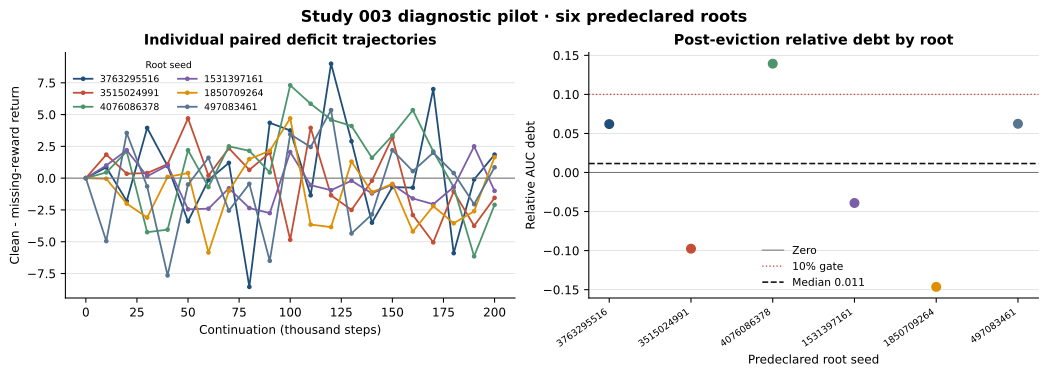
Decision: stop or redesign. The pilot does not authorize the planned exposure-versus-residency study.
THE READING
No stable directional effect.
The pilot does not prove that the exact effect is zero. Six roots cannot characterize the full training distribution. They are sufficient to reject the continuation rule written for this project: this fault, learner, task, and outcome did not produce a signal stable enough for the proposed mechanism study.
The stop is empirical rather than technical. Every checkpoint learned above the fixed health threshold, every clean continuation remained healthy, and every exact sham passed. Enlarging the fault beyond the declared maximum, searching intervention times, or retaining favorable roots would answer a different question after seeing the result.
THE RECORD
The result remains inspectable.
The compact record includes one row per independent training root, every unsmoothed paired evaluation, the machine-readable gate decision, and the figure. The repository contains the frozen protocol, declared roots, checkpoint-fork implementation, replay instrumentation, and analysis.
Root metrics (CSV)Paired evaluations (CSV)Gate record (JSON)Figure (SVG)
Open the protocol and code